A lake can look quiet while something significant accumulates far below its surface. At Lake Nyos in northwestern Cameroon, deep water had become a store of dissolved carbon dioxide. On the evening of 21 August 1986, a large quantity of that gas escaped and spread into surrounding valleys.
More than 1,700 people lost their lives. Communities were left facing an immense loss and a troubling scientific question: how could a body of water produce such an event without a conventional volcanic eruption? Investigators found that the answer depended on the relationship between gas, water pressure and a lake whose deeper layers did not regularly mix with the surface.
The first task was to explain the evidence
The U.S. Geological Survey’s 1987 investigation brought together geological, chemical and medical observations. Its conclusions separated the source of the carbon dioxide from the mechanism that released it. The gas originated deep within the Earth, but the investigators found no evidence that direct volcanic activity had driven the August event.
That distinction is fundamental. A crater lake can occupy a volcanic landscape without every disturbance being an eruption of fresh magma. At Nyos, water had stored gas over time. Understanding that reservoir offered a different explanation from imagining a sudden blast of hot volcanic material through the lake bed.
The report also treated the initiating disturbance cautiously. It did not identify a proven trigger. That uncertainty should remain part of the story, even though a named landslide or earthquake would make a simpler narrative. Investigators could explain the process of release more confidently than the precise event that started it.
A reservoir hidden in water
NASA’s account describes carbon dioxide from deep magmatic sources reaching the lake through groundwater. Much of the gas remained dissolved in the deeper water. It was not a single enormous bubble waiting beneath a surface lid, an image that can make the mechanism harder to understand.
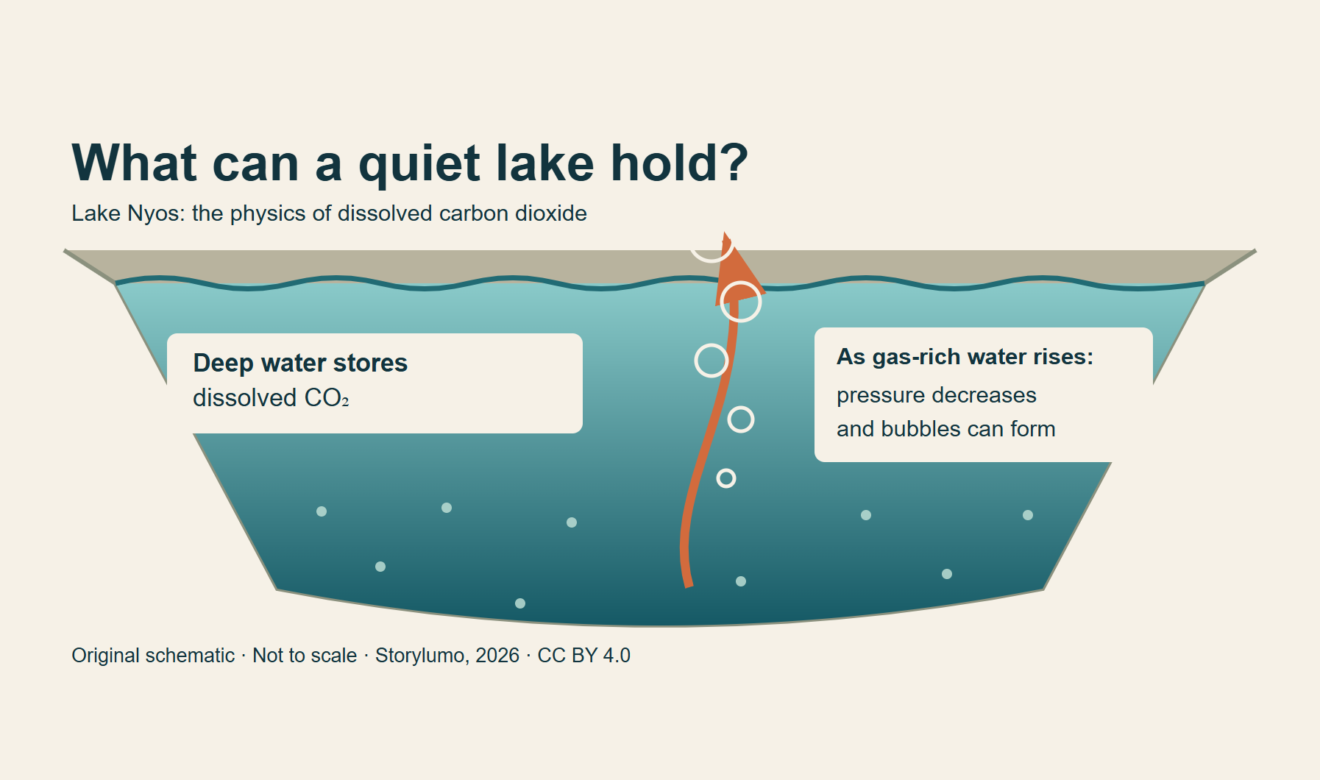
Pressure increases with depth in a lake. Under suitable conditions, water at greater pressure can retain more dissolved carbon dioxide than the same water near the surface. At Nyos, the persistence of deep layers allowed a substantial gas inventory to accumulate without being continually carried upward and released in small amounts.
A familiar fizzy drink offers a limited analogy: lowering pressure can make dissolved gas emerge as bubbles. A lake, however, has no bottle cap, and the details involve temperature, density, dissolved substances and movement through a large water column. The analogy explains pressure’s role; it does not reproduce the entire event.
When rising water starts to bubble
If sufficiently gas-rich deep water moves upward, the pressure around it falls. Carbon dioxide can then separate from solution. Bubbles expand as they rise, and the gas-water mixture can become buoyant enough to draw more deep water upward. A disturbance can therefore develop into a much larger release.
The term limnic eruption is used for this kind of lake-gas event. It describes the release from the lake rather than a conventional eruption of lava. The original investigation examined the lake’s temperature, chemistry and sediment evidence to distinguish between explanations that might look similar from a distance.
The schematic above illustrates only the essential mechanism. Its pale circles represent gas remaining dissolved at depth; the bubbles in the rising plume represent gas emerging from solution. These symbols are explanatory devices. They are neither a reconstruction of the precise 1986 plume nor a photograph of what witnesses saw.
Why the valleys mattered
Carbon dioxide is denser than ordinary air under comparable conditions. In a large, concentrated release, the gas-rich mixture can spread along low ground. The terrain around Nyos helped direct its movement, connecting the physical behavior of the gas with the geography of affected settlements.
Researchers have continued to study that movement. A 2017 paper in Natural Hazards and Earth System Sciences used high-resolution modeling to examine the dispersion of dense gas during the event. Such reconstructions test how terrain and atmospheric conditions may have influenced the flow; they should not be mistaken for direct measurements made during the night itself.
Carbon dioxide is invisible. Describing a plainly visible cloud rolling toward every settlement would give readers a misleading sense of the warning available. At high concentrations, the gas both reduces the oxygen available in air and directly disrupts normal bodily function. The effects cannot be explained adequately by odor or appearance.
The lake continued receiving gas
An explanation of 1986 was only the beginning. Scientists also needed to know whether carbon dioxide was returning to the deep water. A study published in 1994 examined six years of changes in Lake Nyos, showing why repeated sampling mattered after the immediate emergency.
A lake’s calm appearance could not answer that question. Measurements at different depths were needed to estimate the amount of dissolved gas and its relationship to pressure. Monitoring converted an almost invisible process into a set of observations that could guide decisions about reducing the hazard.
A pipe turned the same physics toward prevention
Controlled degassing began at Nyos in 2001. A pipe brought gas-rich water upward from depth. As pressure decreased inside the pipe, bubbles formed and helped lift the water, sustaining the flow once it had been initiated. The engineering used the same tendency to release dissolved gas, but confined it to a managed route.
A 2005 study in the Proceedings of the National Academy of Sciences examined the early operation of systems at Nyos and nearby Lake Monoun. Monitoring was crucial because researchers needed to establish that removing gas was improving conditions rather than destabilizing the wider water column. Their results supported the controlled approach.
Later research, published in 2008, followed changes before and during degassing. It documented declining gas inventories during the study period. As the reservoir changes, the behavior of the equipment can change too, making continued assessment part of the engineering task rather than an optional final check.
Understanding without declaring the story finished
Those studies establish a history of scientific progress and intervention. They do not, by themselves, certify present-day safety or settle every question about 1986. A responsible account keeps the dates attached to findings and leaves room for continuing monitoring, local knowledge and the needs of surrounding communities.
Lake Nyos expanded understanding of what a lake can contain beneath an undisturbed surface. Its story brings together chemistry, landscape and engineering, but it begins with people and a profound community loss. The most useful response to its strangeness is careful explanation: what accumulated, how it escaped, and how measured intervention sought to prevent another sudden release.
Sources and further reading
- U.S. Geological Survey: investigation of the August 1986 Lake Nyos event, Open-File Report 87-97 (1987)
- NASA: Lake Nyos, Cameroon
- Evans and colleagues: six years of changes in lake gas content (1994), USGS publication record
- Kling and colleagues: controlled degassing of Lakes Nyos and Monoun (PNAS, 2005)
- Kusakabe and colleagues: evolution of carbon dioxide before and during controlled degassing (2008), USGS publication record
- Folch and colleagues: modeling dense-gas dispersion at Lake Nyos (2017)
Image Credits
Original schematic created for Storylumo, 2026, released under CC BY 4.0. Scientific basis: USGS Open-File Report 87-97 and the studies cited above. No third-party photograph or illustration was incorporated. This is an explanatory diagram, not a historical photograph or a reconstruction of the exact 1986 event. Resized and automatically cropped for website display.