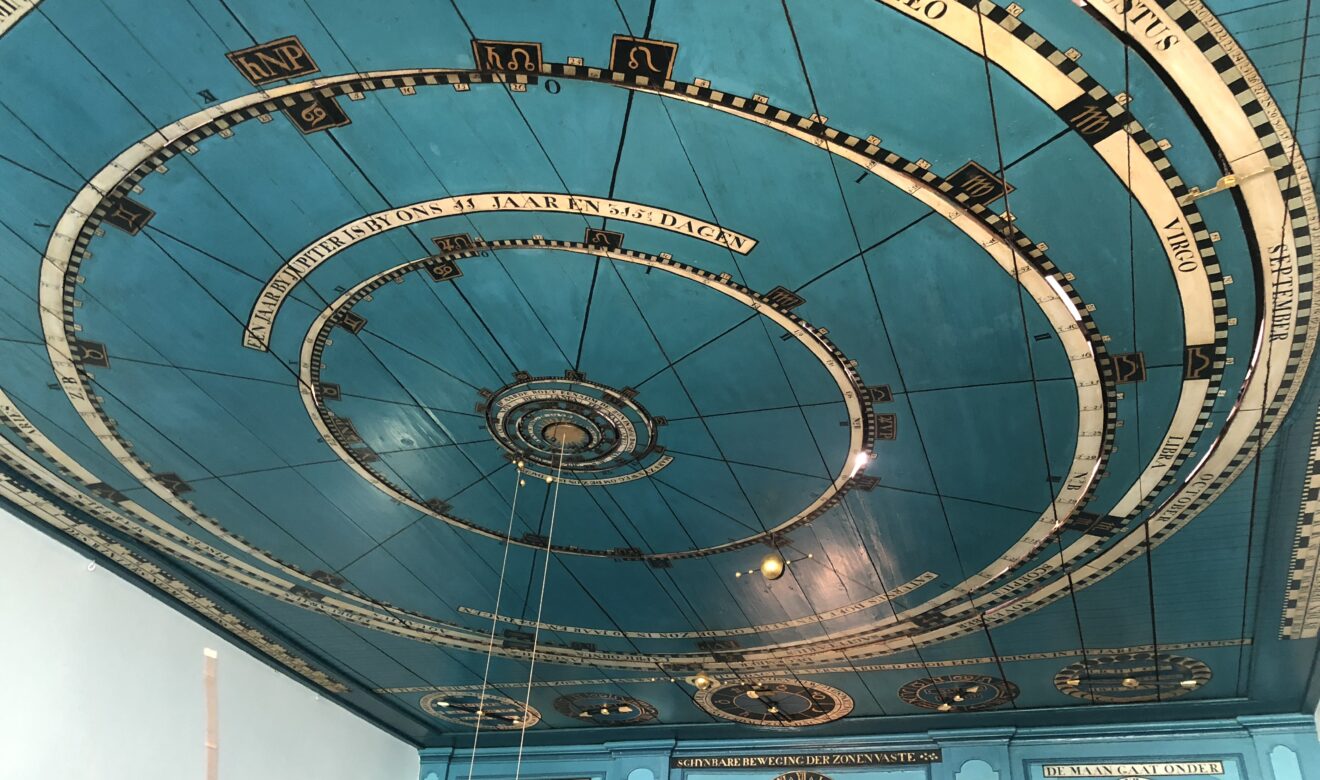
Look up in a small room in Franeker, in the northern Netherlands, and the ceiling becomes a map in motion. Painted rings circle a Sun; small spheres hang below them. This is Eise Eisinga’s mechanical planetarium, built into the home where he lived. The machinery belongs to the eighteenth century, yet its purpose is still to show where the planets are.
Eisinga worked in the wool trade. Between 1774 and 1781, he turned his living room into a working model of the solar system. A domestic ceiling became an astronomical instrument, with the household living beneath it. Understanding how it was made and kept alive takes us beyond the familiar image of an isolated genius.
The wool comber who studied the sky
Eisinga was born in Dronrijp on 21 February 1744. According to the planetarium museum’s history, he attended primary school and worked in his father’s wool-combing business. He also studied mathematics with Willem Wijtses, a wool dyer in Franeker. His route into astronomy passed through lessons, books and skilled work, rather than a formal university career.
In 1768, he married Pietje Jacobs and settled in Franeker as a wool comber. Astronomy was not simply a pastime that replaced his occupation. The home and business formed the setting in which his ambitious instrument took shape. Calling him an amateur describes his relationship to astronomy; it should not suggest that he approached its mathematics casually.
A room becomes an instrument
The blue ceiling is both a decorated surface and a working display. Concentric tracks, written labels and suspended globes make its subject readable from below. In the featured photograph, taken in 2018, the model fills the view while further astronomical dials appear on the wall. This is a modern view of a historic instrument, not a surviving eighteenth-century photograph.
The museum describes a mechanism of wooden hoops and discs with iron pins, controlled by a single clock movement. Much of the engineering is concealed above the visible display. The design lets people stand underneath the model rather than gather around a small object on a table. The room itself becomes part of the explanation. The museum’s overview describes both the historic model and its continuing educational role.
One clock, several kinds of time
The instrument is an orrery: a mechanical model representing the motions of bodies in the solar system. The Linda Hall Library’s account explains that a weight-driven pendulum clock supplies its motion. Wooden gears and pins transmit that motion through the mechanism. Different gear relationships allow the same clock to govern displays that must move at different rates.
Those displays do more than send planets around the Sun. They also indicate information such as the time of day, the calendar and the Moon’s phase. The machinery brings different cycles together in a form that can be inspected. A clock usually answers one immediate question—what time is it? Here, clockwork helps locate that moment within a much larger pattern.
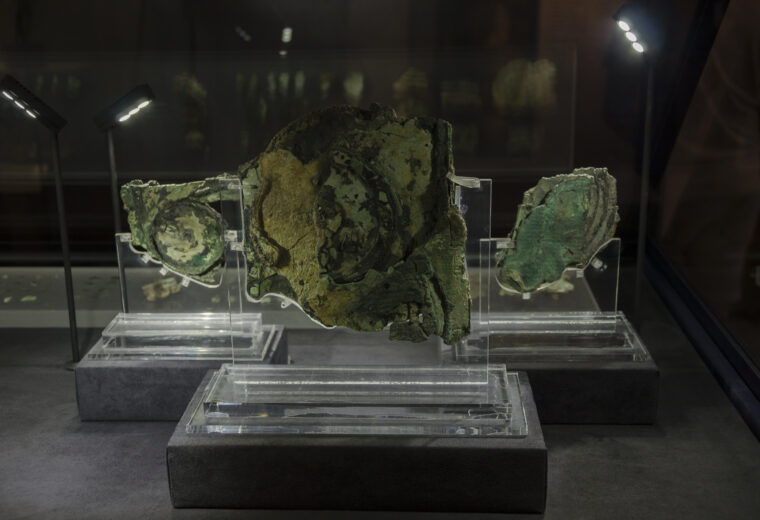
Storylumo’s account of the Antikythera Mechanism explores another way of expressing astronomical cycles through gears. Eisinga’s instrument belongs to a different period and tradition, but both make the relationship between mathematics and machinery tangible.
Why there are six planets
The ceiling represents Mercury, Venus, Earth, Mars, Jupiter and Saturn. That is the planetary system known when Eisinga began his work. Its planets proceed in real time, rather than racing through years in a short demonstration. UNESCO describes the distances in the model as scaled, with the display integrated into the ceiling and the wall of the former living room and bedroom. Historian Arjen Dijkstra gives the distance scale as 1:1,000,000,000: one centimetre represents a million kilometres.
A real-time model asks for patience. During a brief visit, its slow movement can be harder to notice than its elaborate decoration. That is part of its meaning: the machinery keeps following a timetable that is not arranged for a visitor’s convenience. The display relates an ordinary day in the room to the continuing movements beyond it.
Its completion year contains a striking coincidence. On 13 March 1781, William Herschel observed the object subsequently recognised as Uranus. NASA’s history of the discovery explains that he initially thought it was a comet. The known planetary system was expanding just as Eisinga’s six-planet ceiling was being completed. The missing Uranus records a particular stage of astronomical knowledge.
The apocalypse story needs care
A familiar explanation links the project to a conjunction of planets and the Moon on 8 May 1774. In this version, alarming predictions associated with the preacher Eelco Alta prompted Eisinga to build a reassuring model. The museum recounts that story, and it is easy to see why it has endured: it gives an intricate machine a simple dramatic cause.
Historian Arjen Dijkstra offers a more cautious interpretation in Eise Eisinga’s World. He traces the influential tale through Jean Henri van Swinden’s publicity for the planetarium and questions the exaggerated image of a lone rational hero defeating superstition. Eisinga had training, a successful business and practical assistance from family members. Those circumstances helped make the project possible.
The distinction matters. We can document a remarkable instrument without pretending to know one decisive thought inside its maker’s head. Understanding the support around Eisinga also gives credit to the less visible work behind a famous achievement.
Keeping the solar system running
UNESCO’s assessment calls it the world’s oldest continuously operating planetarium, while describing its operation since 1781 more precisely as almost continuous. It has required care and repairs. Its survival is not evidence that wooden machinery can be abandoned for centuries and still function.
Eisinga left detailed maintenance instructions in 1784. UNESCO identifies those instructions, together with Van Swinden’s 1780 description, as important evidence for the instrument’s authenticity. They helped later custodians understand what they had inherited. Preservation here means keeping knowledge of operation alongside the material object.
The achievement is still easy to grasp from the room below. A wool worker and his collaborators made an enormous subject fit inside a home; generations of custodians kept it intelligible. The ceiling survives as more than a beautiful remnant. Its continuing motion lets the original idea remain an experience: stand in an ordinary room, look up, and find yourself inside a model of the solar system.
References
- Royal Eise Eisinga Planetarium: History and the planetarium and its mechanism.
- William B. Ashworth Jr., Linda Hall Library: Eise Eisinga (mechanism and displays).
- NASA: Herschel’s observation and the discovery of Uranus in 1781.
- Arjen Dijkstra, “Eise Eisinga’s World,” in Cultivating and Communicating Natural and Technical Knowledge around 1800: Devotees of Science, Amsterdam University Press, 2025, pp. 49–76 (open-access volume; historical context and the conjunction story).
- UNESCO World Heritage Centre: Eisinga Planetarium in Franeker (design, operation and preservation).
Image Credits
Featured image: Planetarium Eise Eisinga in Franeker, photograph by Erik Zachte, 2 September 2018, own work via Wikimedia Commons. Licensed CC BY-SA 4.0 International. The display may crop or resize the original photograph; any cropped display version is offered under the same license. No retouching. The photograph shows an eighteenth-century instrument in 2018; it is not a historical photograph of Eisinga.