When divers recovered objects from a shipwreck near the Greek island of Antikythera in 1900–01, the cargo included sculpture, glassware and a corroded lump of bronze. Only after its fragments were examined did toothed wheels begin to reveal themselves. The object was not a clock in the ordinary sense. It was a device for calculating patterns in the sky, built more than two thousand years ago.
Today the Antikythera Mechanism is often called the earliest known analogue computer. That description captures its ability to turn a physical input into calculated displays, though it was hand-powered and did not work like a modern electronic computer. Its importance lies in the careful marriage of gearwork, astronomy and calendars, much of which researchers have had to recover from broken, mineralized pieces.
A find from a shipwreck
The ship sank near Antikythera in the first century BCE. Sponge divers helped recover its cargo in the first modern phase of work on the wreck, in 1900–01. The National Archaeological Museum in Athens dates the mechanism’s manufacture to roughly 150–100 BCE. Those are different dates: the age of the instrument and the time when the ship carrying it went down.
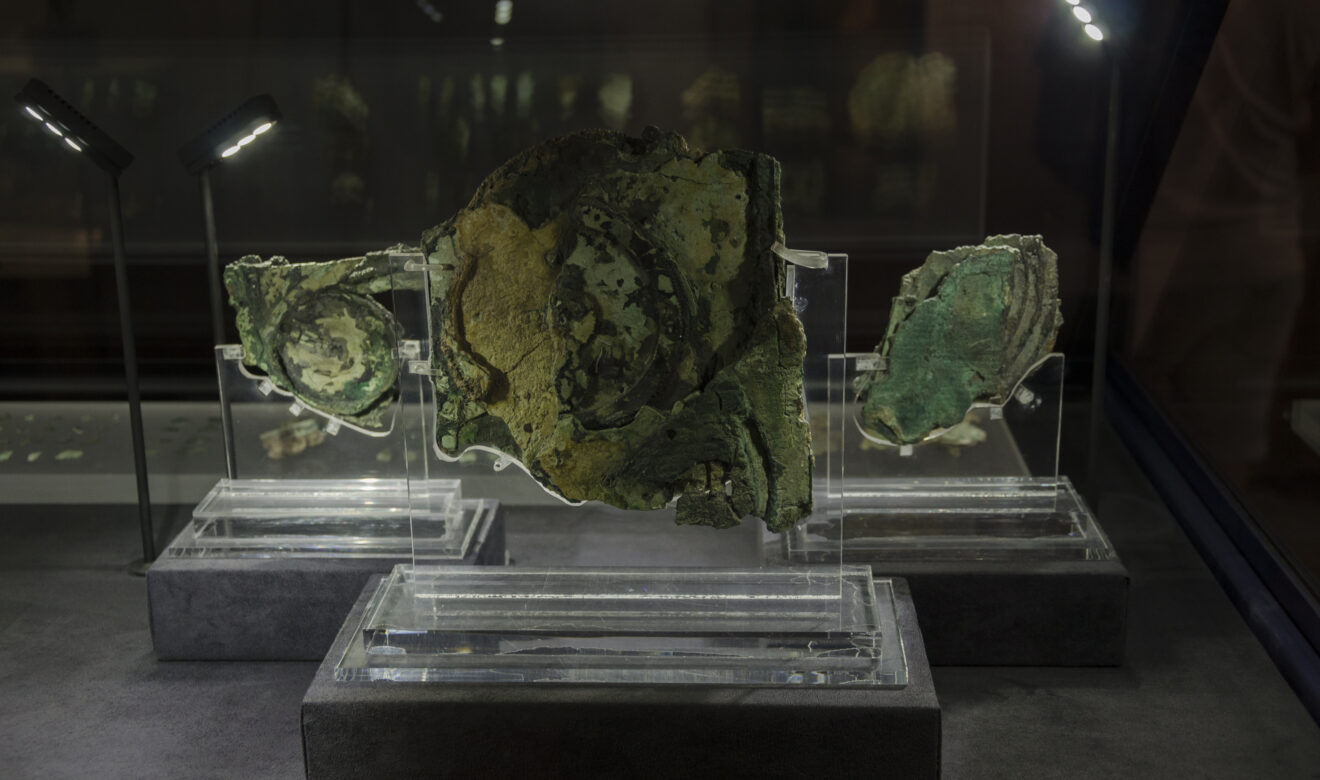
The surviving material is now catalogued as 82 fragments, held by the museum. Seven are larger pieces, identified by letters A to G; 75 smaller pieces are numbered. They do not form a complete machine that can simply be wound up. Lost parts, corrosion and uncertain original positions mean that every reconstruction combines physical evidence with informed interpretation.
Early researchers noticed the gears but disagreed about the device’s purpose. Some regarded it as an astrolabe or navigation instrument. In the twentieth century, historian of science Derek de Solla Price and physicist Charalambos Karakalos used X-ray images to study its internal structure. Later teams used more detailed imaging and three-dimensional X-ray tomography to inspect concealed teeth and inscriptions.
Turning a handle to turn time
At the heart of the mechanism is a system of bronze gearwheels. A gear with one number of teeth drives another at a particular ratio, allowing a turn of the input to represent a much longer or shorter astronomical cycle. The National Archaeological Museum’s educational material explains the basic principle: linked gears can convert one rotation into another at a controlled speed.
The device’s displays related the solar year to lunar months. That mattered because twelve lunar months do not exactly fill a solar year. One cycle encoded in the mechanism is the 19-year Metonic cycle, which corresponds to 235 lunar months. A dial could therefore help place lunar months within a repeating calendar scheme rather than leaving the two ways of reckoning time to drift apart without correction.
The mechanism also modeled eclipse cycles. The Saros cycle, about 223 lunar months, describes a period after which eclipses recur in a broadly similar pattern. The museum describes an additional Exeligmos cycle of three Saros periods, used to correct the timing of eclipse indications. These were predictions based on repeating cycles, not claims that every eclipse could be viewed from every place.
Research published in Nature in 2008 connected the back dials with the Metonic calendar, eclipse prediction and an Olympiad dial. That last feature linked astronomical reckoning with the schedule of games. The instrument thus joined scientific knowledge to human calendars and public life. It was useful because the sky, civic time and ritual occasions were not separate subjects in the ancient world.
Words hidden in bronze
The gears are only part of the evidence. The mechanism carried densely written Greek inscriptions on its plates. Some text described astronomical and calendrical functions and helped explain how a user should read the displays. Many letters were invisible on the surface until imaging techniques exposed writing inside the corroded mass.
Those inscriptions are a check on imaginative reconstructions. They tell researchers something about what the device was meant to show, even when the relevant hardware is gone. They also show why it should not be treated as a mysterious machine without a cultural setting: it was built for people who could read its directions and understood the cycles it represented.
The front display remains especially difficult to reconstruct. A research team at University College London published a model in 2021 that fits much of the surviving physical and inscriptional evidence and proposes gearing for a display of the ancient Greek cosmos. It is a research model, not a recovered intact front face. Distinguishing surviving components from reconstructed ones keeps the machine impressive for the right reasons.
What the mechanism changes
No surviving ancient instrument matches the Antikythera Mechanism in all its complexity. That does not prove that its maker worked alone or that every technical tradition behind it has vanished without trace. The National Archaeological Museum places it within a world that already knew gears, mathematical astronomy and precision instruments. Its exceptional survival gives us a rare glimpse of what such knowledge could produce.
It also shows how much the sea can obscure. Bronze corroded; sections broke; some parts were lost. For more than a century, researchers in archaeology, epigraphy, engineering and astronomy have had to compare fragments, read faint writing and test mechanical possibilities. Each new imaging method has made a different layer of evidence available, while leaving some questions open.
The Antikythera Mechanism is remarkable without a myth of impossible ancient technology. A person could turn its gearing and consult displays of time and celestial cycles. The fragments show a culture able to make mathematical knowledge tangible in bronze. They remind us that the history of technology is shaped as much by what survives as by what people once knew how to build.
Sources and image credit
- National Archaeological Museum, Athens: Science historian and research timeline, cycles and functions, and inscriptions.
- Antikythera Mechanism Research Project: Catalogue of the 82 fragments and 2008 research on calendars, the Olympiad dial and eclipse prediction.
- University College London: 2021 model of the front display.
- Featured image: Fragments of the Antikythera Mechanism at the National Archaeological Museum, photograph by Peulle, 2017, via Wikimedia Commons. Licensed CC BY-SA 4.0; the featured display version is cropped from the original photograph.