The Lycurgus Cup can look like two different objects without changing its shape. Light falling onto it reveals greenish glass. Light passing through it makes the same vessel glow red. The effect belongs to the material itself: this fourth-century Roman cup contains tiny particles of precious metals that alter how it interacts with light.
The surprise is not only optical. Figures project from its surface in an intricate openwork cage, telling the story of a king caught in a vine. Its maker combined demanding glass carving with an unusual material whose behaviour still attracts scientific investigation. Understanding that achievement means looking at the sculpture, the glass and the gaps in its history together.
The king caught in the glass
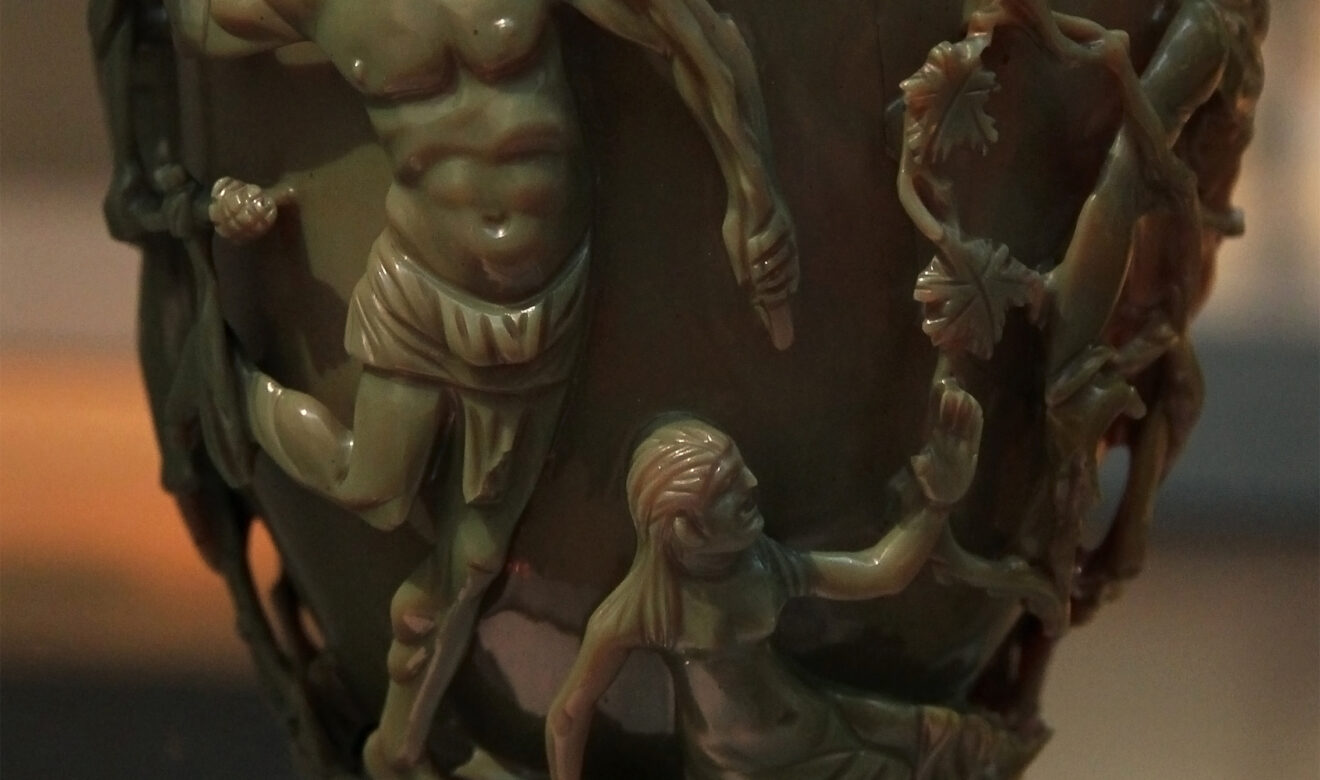
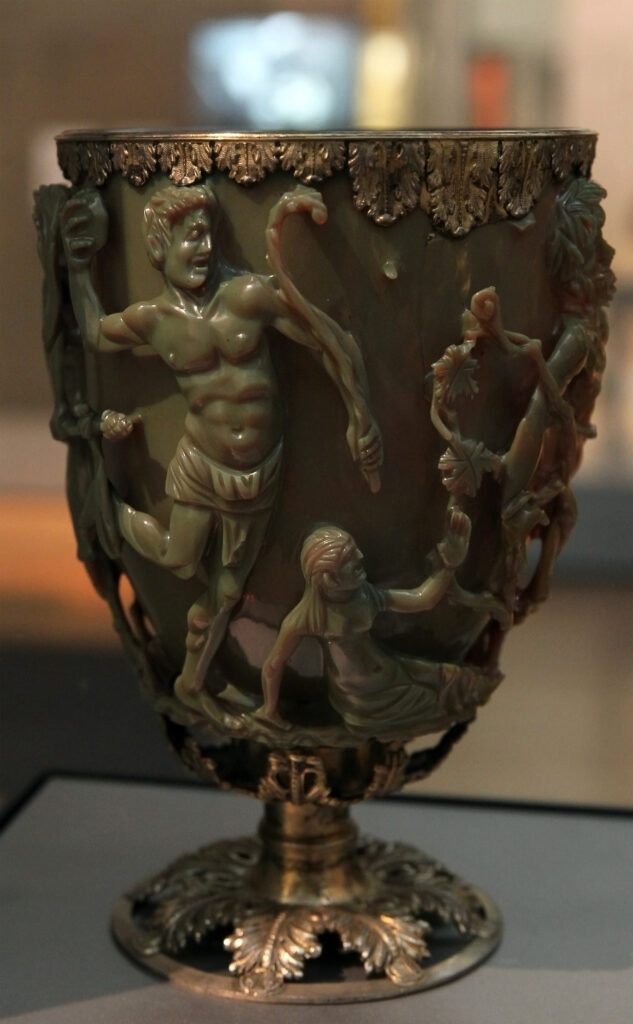
The name comes from Lycurgus, a king of Thrace in Greek myth, rather than from a known owner of the cup. The British Museum’s description on Google Arts & Culture explains the scene: Lycurgus attacked Dionysus and the nymph Ambrosia. She appealed to Mother Earth, became a vine and trapped him in her coils. Dionysus and his companions surround the struggling king.
It is a scene of transformation on an object that itself seems to transform. That correspondence makes the cup especially memorable, although it does not establish why its patron selected the subject. The scene can be identified; the circumstances of the commission cannot. Looking closely at the figures gives us something firmer than imagining a conversation between an unknown customer and an unknown glassworker.
A cage cut from a thick vessel
The outer decoration is not a separate metal framework. The figures and their connecting elements belong to the glass. The museum describes manufacture beginning with a thick blank, blown or cast, which was then cut and ground away. Small bridges connect projecting sections to the body, producing the effect that gives cage cups their name.
This is a demanding way to make ornament. Removing material creates the spaces that make the relief appear almost detached, while leaving enough support to preserve the design. A mistake could destroy work already completed. The visual lightness therefore represents careful subtraction, not a flimsy structure assembled around an ordinary finished goblet. Even before considering its colour, the vessel records exceptional control over a difficult material.
How one cup produces two colours
The useful word is dichroic: the appearance differs between reflected and transmitted light. Tiny gold and silver particles dispersed in the glass contribute to that contrast. A 2020 study in the Beilstein Journal of Nanotechnology identifies those nanoparticles as the basis of the cup’s characteristic effect and uses them as inspiration for a modern composite.
The position of the light source is therefore essential to any demonstration. A photograph made in one lighting arrangement cannot show the entire experience. Seen in reflection, the glass returns a different distribution of visible light from the light that passes through it. Nothing needs to be poured into the cup, and the change does not require the glass to be heated. The familiar claim that it “changes colour” is convenient shorthand for two ways of seeing the same material.
Why gold need not look gold
A nanoparticle is small enough that familiar expectations about a bulk material may fail. The US National Nanotechnology Coordination Office places the nanoscale at approximately 1–100 nanometres; one nanometre is a billionth of a metre. At those dimensions, physical and optical properties can differ markedly from those of a large piece of the same substance.
Its explanation of nanoscale properties gives gold as an example: nanoparticles can appear red or purple depending on their size. A gold bar is therefore a poor guide to every appearance gold can produce. Size and structure matter alongside chemical identity. In the cup, material too small to distinguish with the naked eye helps determine the colour of an object that fits in a person’s hands.
The explanation still invites experiments
Knowing the ingredients is not the same as reproducing the whole effect. Researchers must consider particle sizes, composition, the surrounding glass and the interaction of absorption with scattering. A 2021 replica-glass study investigated both metal nanoparticles and separation within the glass into different phases. Its authors highlighted the role of light scattering by silica-rich droplets in their experimental material.
That result adds useful precision to a popular story often reduced to “the Romans added gold.” Experimental replicas allow explanations to be tested, but they do not automatically reveal the exact ancient workshop procedure. The distinction keeps the science interesting: a surviving object can supply a target while leaving several questions about how its makers reached it.
Recreating an effect is a different achievement
The 2020 Beilstein team embedded silver nanoparticles in a material suitable for 3D printing, then added gold nanoparticles to obtain a composite displaying the cup’s green-to-red contrast. This was a modern route towards a related optical result. It did not produce a Roman carved-glass vessel or prove how the original workshop operated.
In October 2026, the University of Sheffield announced another approach: technician Lisa Hollands and colleagues had made dichroic glass for a contemporary sculpture by Elliot Walker. The project drew on a composition derived from a fragment of the ancient material. Glassmaking knowledge, experimental work and an artist’s interpretation came together to let a new audience experience the changing appearance.
What “Roman nanotechnology” can mean
The phrase is striking, but it needs a careful definition. Modern researchers can describe nanoscale structures in the ancient glass. That does not show that its makers possessed microscopes, a modern theory of light or the ability to measure nanoparticles. Practical craft knowledge and a present-day explanation are different kinds of knowledge, and both deserve attention.
Ian Freestone and colleagues’ 2007 study, “The Lycurgus Cup—A Roman Nanotechnology,” examines the technical achievement while noting the limited surviving evidence. The cup does not supply its own manufacturing manual. The material can be analysed much more securely than the intentions of an unnamed glassmaker can be reconstructed.
A long history with a missing beginning
The same study records the cup’s appearance in print in 1845 and notes that its early history and findspot are unknown. In 1958, the British Museum acquired it from Lord Rothschild with support from the organisation now known as Art Fund. Those documented modern chapters should not be mistaken for a continuous biography stretching back to its creation.
A related caution appears in research on the changing lives of archaeological objects: surviving things can be kept, reused and altered across generations. Like Storylumo’s Antikythera Mechanism, the Lycurgus Cup becomes more compelling when examined through evidence rather than a legend of impossible technology. Its carved figures and remarkable glass remain achievements we can see, even where the story of its making remains incomplete.
References
- British Museum via Google Arts & Culture: The Lycurgus Cup, object 1958,1202.1.
- Ian Freestone et al., Gold Bulletin 40 (2007), pp. 270–277: The Lycurgus Cup—A Roman Nanotechnology.
- Lars Kool et al., Beilstein Journal of Nanotechnology 11 (2020), pp. 16–23: dichroic 3D-printing composite.
- Andrey Drozdov et al., Journal of Cultural Heritage 51 (2021), pp. 71–78: replica glass and dichroism (publisher preview).
- US National Nanotechnology Coordination Office: Nanoscale definition.
- US NNCO: What Is So Special about Nano?.
- University of Sheffield: glassmaking and contemporary sculpture project, 26 October 2026.
- Art Fund: The Lycurgus Cup, acquisition support.
- Victoria A. Sainsbury et al., Antiquity 95 (2021), pp. 215–227: Mutable objects, places and chronologies.
Image Credits
Featured and inline photograph: Vassil, British Museum The Lycurgus Cup 01 15022019 4376, 2019, own work via Wikimedia Commons file record. Released worldwide under CC0 1.0 Universal. The featured display uses a cropped detail; the inline photograph shows the full vessel, resized. No additional retouching or artificial colour change. The photograph records one lighting arrangement, not a before-and-after demonstration. The metal rim and foot are later additions to the ancient glass.