The first runner back was not the winner. On 30 August 1904, Fred Lorz returned to the Olympic stadium in St. Louis ahead of the other competitors. There was one substantial problem: after leaving the race, he had traveled part of the route in a motorcar.
Thomas Hicks would receive the marathon title instead, after a journey involving extreme fatigue, assistance from his handlers and a sporting culture very different from today’s. Their stories are often assembled into a collection of comic mishaps. But the race becomes more revealing when the jokes give way to a question: what had the organizers asked these athletes to endure?
Olympics on the edge of a world’s fair
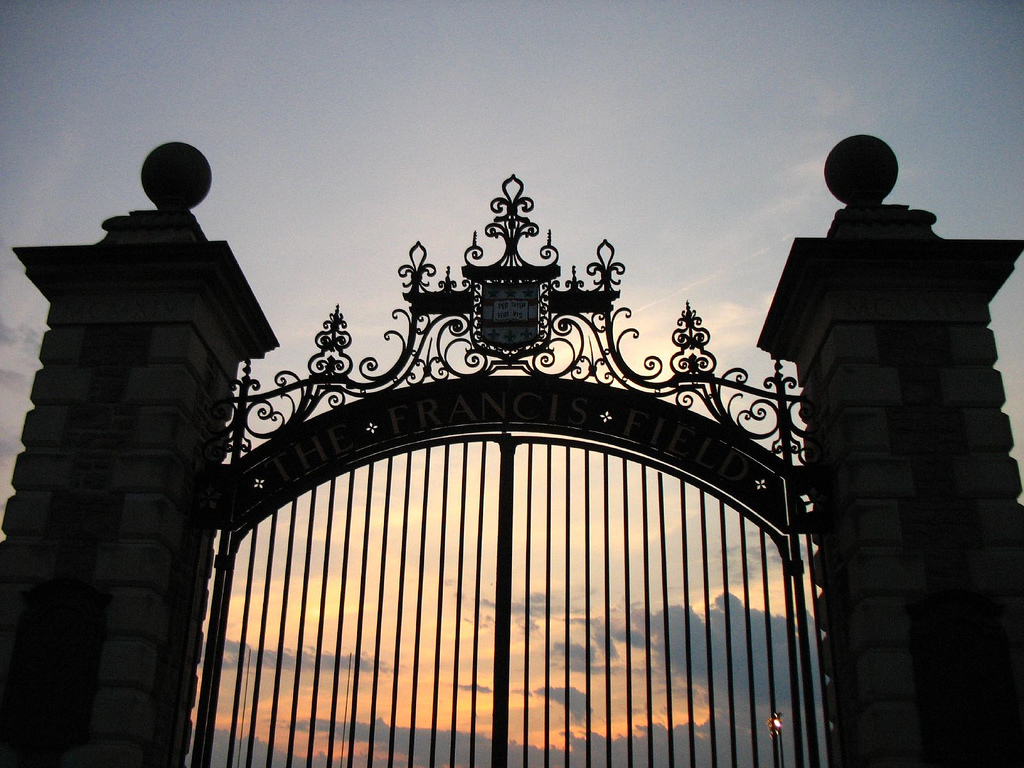
The 1904 Games were held alongside the Louisiana Purchase Exposition, the enormous world’s fair in St. Louis. Washington University Libraries explains that university buildings and grounds became part of the fair’s arrangements. Francis Field, on the campus, served as the main athletics venue and the marathon’s point of departure and return.
The setting helps explain why the event feels unfamiliar. The Olympics had not yet acquired the tightly packaged identity of a modern Games. In St. Louis, sport shared attention with a sprawling exposition. The fair also included the discriminatory competitions known as Anthropology Days, a separate program whose treatment of participants reflected colonial and racial hierarchies. That wider context deserves recognition alongside the marathon’s unusual incidents.
The featured photograph shows the entrance to Francis Field in 2006. It records the later appearance of the historic venue, rather than the race itself. The surviving place offers a connection to an event whose most frequently repeated details otherwise seem almost detached from a real landscape.
An afternoon start in oppressive heat
Olympedia’s event record places the start at 3 p.m. on 30 August. The IOC’s retrospective describes temperatures of about 33°C. Competitors then faced an undulating road course, with vehicles accompanying the race and raising dust. Breathing, footing and pacing all became part of the same struggle.
Even the distance requires care. Historical accounts give differing measurements for the St. Louis route, and the marathon had not yet settled on today’s standard 42.195 kilometers. It is safer to describe the course as roughly 25 miles than to pretend that its length is known with modern road-race precision.
That uncertainty also discourages easy comparisons between Hicks’s finishing time and modern performances. A stopwatch cannot isolate the effects of rough roads, hills, weather and limited support. The numbers record an outcome, but understanding the achievement requires rebuilding the conditions around them.
Water was scarce by design
The IOC account identifies only one water station along the course, near the 12-mile point. It links the restriction to the organizers’ beliefs about the effects of dehydration. Whatever the intended reasoning, runners had very little opportunity to replenish themselves during a hot and dusty afternoon.
The same account records 32 starters and 14 finishers. More than half therefore left the competition before completing it. Rather than a backdrop to the anecdotes, that attrition is central to the story. The race’s unusual finish unfolded after its conditions had already reduced the field dramatically.
Stories of personal resilience can obscure responsibility for the event itself. Heat was beyond the organizers’ control; the starting arrangements, access to water and management of accompanying traffic involved choices. The 1904 marathon allows those choices to be examined without assuming that suffering alone made an event a meaningful sporting test.
The man who arrived by car
Lorz stopped running and accepted a lift. After the car broke down, he continued on foot and reached the stadium before the competitors who had covered the route without that shortcut. His early arrival briefly created the appearance of a victory, but he was disqualified.
The episode is sufficiently extraordinary without adding imaginary dialogue or a perfectly timed medal ceremony. Accounts differ in the theatrical details. The essential distinction is well established: arriving at the finish first did not establish that Lorz had completed the course as a competitor.
Nor did St. Louis end his athletic story. The Boston Athletic Association lists Frederick Lorz as the winner of its 1905 marathon. Remembering that later result makes him a more interesting historical figure than a permanent punchline: a capable distance runner whose most famous Olympic appearance failed the basic requirement of covering the route.
Hicks and the accepted result
The contemporary Spalding athletic almanac records T. J. Hicks of the Cambridge YMCA as the marathon winner, in 3 hours, 28 minutes and 53 seconds. Albert Corey appears next in the results, followed by Arthur Newton. That printed result anchors the race beneath the many later retellings.
The IOC describes Hicks receiving egg whites, brandy and strychnine sulphate from his handlers. Strychnine, a substance with serious health risks, was used as a stimulant in that period; its appearance here should be understood as a historical practice, not a model for athletic preparation. Hicks was also physically assisted as he struggled toward the finish.
The result was nevertheless accepted. The contrast with Lorz can look inconsistent through modern eyes, but the two situations involved different questions: traveling over part of the course in a vehicle and receiving assistance while covering it. The IOC notes that explicit restrictions on drugs appeared in the marathon rules for the 1908 Games. Present-day regulations should not be silently projected backward.
The competitors beyond the famous pair
Cuba’s Félix Carvajal finished fourth. The IOC’s retrospective recounts stomach trouble after he ate fruit during the race, an episode frequently repeated in summaries of the event. Such colorful accounts belong with an indication of their source, rather than being expanded into an invented scene with imagined thoughts or conversations.
Len Taunyane and Jan Mashiani, the South African runners listed ninth and twelfth, also completed the course. The IOC recalls Taunyane being chased off course by dogs. Their names should remain part of the account, rather than disappearing behind a story told only through the apparent winner and the official champion.
A result worth reading with its context
The 1904 marathon offers no shortage of surprises. Its lasting interest, however, lies in the gap between a recognizable sporting ambition and the arrangements surrounding it. Competitors sought an Olympic finish while officials were still establishing what such an event should provide, permit and measure.
Hicks’s name belongs in the record book. Around that single line sits a much larger story about roads, water, medical beliefs, uneven rules and the people who continued despite the conditions. Remembering those details makes the race more extraordinary—and more human—than a list of mishaps alone.
Sources and further reading
- International Olympic Committee: retrospective on the St. Louis marathon
- Olympedia: event record and results
- Washington University Libraries: the Games and the St. Louis exposition
- Spalding’s Official Athletic Almanac: contemporary results, page 223 (LA84 Foundation scan)
- Boston Athletic Association: historical results, 1905 (2026 media guide)
- St. Louis County Library: research guide to the marathon
Image Credits
Gates to Francis Field, 2006. Photograph by Baili Min, originally shared on Flickr and archived on Wikimedia Commons. The file-level permission permits redistribution, adaptations and commercial use with attribution, confirmed by Wikimedia VRT ticket 2007010910012474. Resized and automatically cropped for website display; no other editorial alterations.
Original image and provenance · Attribution permission: all uses, including commercial