The curtains at the Palace of Westminster were treated with chloride of lime. It was an extraordinary response to an extraordinary summer: the river outside Parliament had become so offensive that attempts to keep its smell out of the building became part of the business of government.
In 1858, London’s sewage problem finally reached people who could authorize a solution. For residents beside the Thames, the polluted river was already familiar. What changed was the heat, the intensity of the smell and the political urgency. The episode became known as the Great Stink, and the engineering that followed reshaped much more than the drains.
A growing city, an overloaded river
London Museum estimates that the capital’s population had doubled between 1800 and the 1850s, reaching more than 2.5 million by 1858. More people meant more waste, while industrial activity added its own discharges. The Thames served simultaneously as a working waterway, a water source and the destination for material the city wanted to remove from its streets.
Household improvements could make the collective problem worse. Flushing toilets moved waste away from individual homes, but old drainage channels delivered much of it into the river. A cleaner room did not necessarily produce a cleaner city. The nuisance had simply traveled downstream—or waited nearby for the next turn of the tide.
That tidal movement frustrated the comforting idea that a river would carry everything away. Historic England’s account describes a waterway burdened by domestic sewage and industrial effluent. The capital had expanded faster than its arrangements for handling what expansion produced. Its drainage needed to work as a connected system rather than a collection of local exits.
The summer Parliament could smell
During the hot summer of 1858, low water exposed foul deposits along the river. London Museum describes weeks of temperatures above 30°C. Heat intensified the odor, and Westminster’s riverside location gave politicians an immediate encounter with conditions that many Londoners could not escape.
Disinfected curtains offered little prospect of solving a problem spread across the capital. The museum records that legislation enabling the response passed through Parliament in just 18 days. Speed at Westminster, however, should not be confused with the sudden invention of a sewer scheme. Plans had already been discussed; agreement over the money had been harder to secure.
This is the episode’s sharp political irony. Evidence of a citywide problem existed before the most influential people found it unbearable. The summer compressed a long argument about public works into a situation demanding action. The smell did not draw a sewer map. It helped make an existing engineering proposal financially possible.
An engineer with a network to build
Joseph Bazalgette, chief engineer of the Metropolitan Board of Works, was central to the response. His task involved intercepting flows before they entered the central Thames, then directing them east through larger sewers. Instead of allowing each district to discharge near its own streets, London would collect sewage across a much wider area.
Gravity could do much of the work when channels followed suitable gradients. Where the terrain and required levels demanded it, pumping stations supplied the lift. The network therefore depended on a relationship between tunnels, slopes, machinery and river conditions. A handsome engine house was one visible component of an engineering system largely hidden underground.
The original arrangement also had a limitation easily lost in a heroic retelling: it moved sewage away from central London rather than providing the complete treatment people expect from modern sanitation. Outfalls farther east released it with the outgoing tide. Improving conditions in one stretch of river did not make the waste itself disappear.
Crossness: machinery given a monumental home
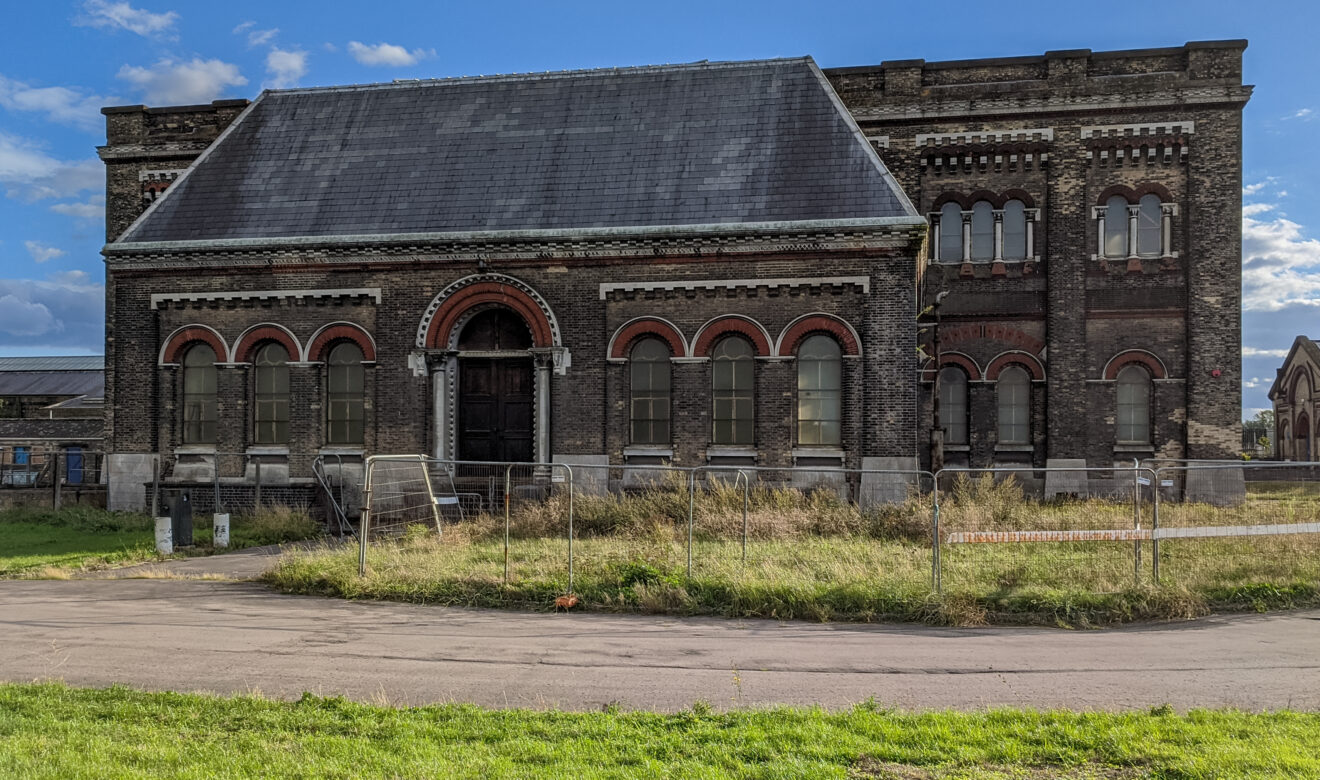
Crossness Pumping Station opened in 1865. The National Lottery Heritage Fund describes its four huge rotative beam engines and the elaborate ironwork inside the building. It is an unusually decorative setting for equipment whose essential purpose was practical: raising sewage so that the wider drainage arrangements could function.
The photograph above shows Crossness in 2020, long after the original works. Its survival helps make an otherwise abstract story tangible. Sewer tunnels are difficult to picture from street level; an engine house shows the scale of the investment and the confidence with which Victorian public infrastructure could be presented.
The Heritage Fund’s account of the station’s restoration also shifts attention toward maintenance. Crossness required dedicated conservation work before reopening to visitors in 2016. Infrastructure has a second history after its construction: repair, adaptation, redundancy and preservation. A project does not remain usable—or understandable—simply because its original builders were ambitious.
The riverbank became a building site
The sewer project changed London’s surface as well as its underground geography. Embankments provided space for major drains while remaking the edge of the Thames. Historic England’s archive photographs document streets and waterfront buildings affected by the works, including changes around Lambeth.
Those images complicate the familiar view of an uninterrupted march toward improvement. River access changed; houses and working premises gave way to a different waterfront. For the city as a whole, the benefits were substantial. For people living and earning a livelihood along particular stretches, construction could mean displacement and the loss of familiar places.
A smell was not a diagnosis
Many Victorians associated illness with foul air, often described through the theory of miasma. Yet John Snow’s investigation of cholera around Broad Street in 1854 had already strengthened the case for contaminated water as a route of transmission. The London School of Hygiene & Tropical Medicine explains that work through the history of the Broad Street pump.
The Great Stink and Snow’s investigation belong to the same wider struggle over urban health, but they were different events. It would be misleading to turn the summer of 1858 into the occasion on which London first understood cholera. Engineering improvements could reduce exposure even while explanations for disease remained contested.
The work outlasted the summer
London Museum places the eventual completion of the sewer project in 1875. That long span is a useful corrective to the image of a city transformed as soon as Parliament acted. Authorization was the beginning of years of digging, masonry, machinery and disruption.
The Great Stink endures as a memorable name because it connects something intimate—a smell nobody wanted in their room—with the scale of collective government. London’s answer required looking beyond individual houses and borough boundaries. The result was a new way of organizing the city’s waste, built into the ground beneath the people who depended on it.
Sources and further reading
- Historic England: archive photographs and the Great Stink
- London Museum: the Great Stink of 1858
- National Lottery Heritage Fund: Crossness and its restoration
- London School of Hygiene & Tropical Medicine: John Snow’s Broad Street investigation
- Royal Museums Greenwich: Dickens and the Great Stink in the archive
Image Credits
Crossness Pumping Station, 5 September 2020. Photograph by The wub, via Wikimedia Commons. Resized and automatically cropped for website display; no other editorial alterations. The displayed image adaptation is offered under CC BY-SA 4.0.