On 10 August 1628, Stockholm watched a new warship begin its first voyage. Vasa carried two gun decks, elaborate carving and the ambitions of a king. It travelled only about 1,300 metres before a gust pushed it over far enough for water to enter its open gunports. Within minutes, the ship was on the bottom of the harbour.
The catastrophe left an extraordinary historical record. There was an inquiry, testimony about a failed stability demonstration, and eventually the ship itself: raised in 1961 after more than three centuries underwater. Together, they tell a story more revealing than a simple joke about a vessel that could not float safely.
A royal project with a dangerous imbalance
Vasa was built in Stockholm between 1626 and 1628 for Gustav II Adolf’s war against Poland-Lithuania. The king’s naval ambitions depended on ships able to carry formidable artillery. The Vasa Museum’s timeline describes the completed vessel as 69 metres long, with ten sails and 64 cannon. Its size made an impression before it ever sailed.
The problem was the relationship between that impressive upper structure and the hull beneath it. A vessel must resist the turning force produced when wind presses against its sails. Vasa’s high, heavy upperworks and insufficiently broad hull left it dangerously unstable. Good workmanship could not compensate for those proportions. The museum’s teacher’s guide stresses that the exact loading and positions of people are unknown; the broad imbalance is clearer than every detail of the final accident.
Thirty men supplied a warning
Before departure, thirty men ran from side to side across the upper deck to make the ship roll. Vice Admiral Klas Fleming witnessed the demonstration. It was stopped after only a few crossings because the movement seemed dangerous. This was a practical warning from the completed ship, requiring no modern calculation to make its significance apparent.
At the later inquest, master Jöran Matsson described what had happened. He was responsible for the ballast: roughly 120 tons of stone intended to lower the ship’s centre of gravity. The troubling demonstration had not led to an effective correction before sailing. Pressure to get the vessel into service helps explain the setting, though it cannot tell us everything each participant privately believed.
The harbour became a rescue scene
The maiden voyage included guests as well as crew. Family members were allowed aboard for the first stage and were supposed to leave before Vasa continued to its fleet base. According to the museum’s account of the disaster, only four of its ten sails were set when it began moving freely down the harbour.
One gust made the ship heel and recover. A stronger gust then forced the lower gunports beneath the surface. Water entering there turned a dangerous lean into a sinking. Captain Söfring Hansson ordered measures to spill wind from the sails and close the ports, but the crisis unfolded too quickly. Nearby boats rescued people; others reached shore or clung to the masts projecting above the water. Roughly thirty people died, although the precise toll is uncertain.
An inquiry without a punishment
The council began investigating immediately, and a formal commission questioned officers and builders in September. Hansson maintained that the crew had been sober and the guns secured. The builders defended their adherence to the approved design. Henrik Hybertsson, the original master shipwright, had died in 1627 and could not answer questions.
The surviving proceedings identify a structural problem, yet nobody was officially punished. The museum interprets the inquiry as constrained by royal approval of the design and the navy’s need for skilled personnel. That distinction matters: understanding why an object failed and deciding whom an institution will hold responsible are different processes. Storylumo’s account of Boston’s molasses tank disaster examines a later, very different struggle over warnings, engineering and accountability.
Recovering more than a wreck
Vasa did not simply disappear from human knowledge for 333 years. Divers recovered most of its valuable bronze guns in the 1660s. What changed in the twentieth century was the possibility of raising the hull as an archaeological object, rather than treating it principally as a store of reusable material.
Anders Franzén’s investigation brought attention back to the wreck in 1956. Raising it required naval divers, salvage engineers, archaeologists and conservators. Between 1957 and 1959, divers excavated six tunnels beneath the hull and passed steel cables through them. The salvage account describes how pontoons lifted the ship in stages into shallower water. Openings then had to be sealed and the fragile structure prepared for its final emergence on 24 April 1961.
Objects recovered from the ship also bring the story down to the scale of daily life. The museum displays shoes, clothing and tools for repairing them, alongside contrasting officers’ and sailors’ tableware. These belongings complicate the image of a royal monument. The vessel carried people preparing to eat, mend clothes and pass idle hours, whose ordinary possessions became archaeological evidence when the voyage ended.
Coming ashore created new problems
Waterlogged wood cannot be treated like a newly cut plank. Drying can produce shrinkage and cracking, so conservation became a long technical undertaking. A conservation paper by Lovisa Dal and Ingrid Hall Roth describes the extensive use of polyethylene glycol, or PEG, to help stabilise Vasa’s timber. Raising the ship was the beginning of that work.
A hidden chemical threat
A later threat developed inside the wood. In a 2002 study in Nature, researchers identified accumulated sulphur compounds capable of oxidising into sulphuric acid. Iron compounds associated with corroded bolts could help catalyse the reactions. The finding exposed a difficult reversal: material that survived underwater could undergo damaging chemistry after recovery. Museum preservation therefore involves investigating changes that visitors cannot see as well as protecting the visible hull.
A survivor that still needs support
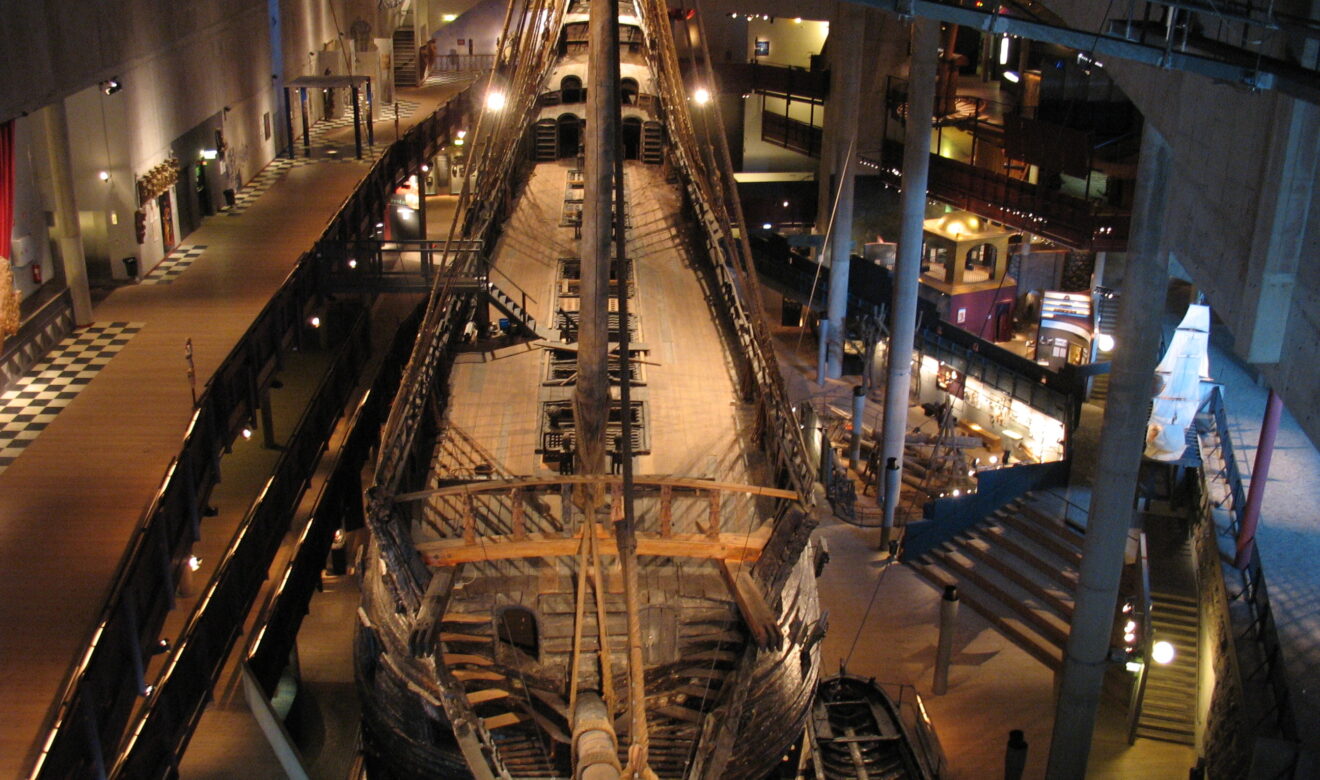
The purpose-built Vasa Museum opened on 15 June 1990. Its institutional history records the ship’s move into the new building on a pontoon in December 1988. The museum was arranged around the vessel, giving a failed warship a second life as evidence that can be studied from several levels.
That evidence remains vulnerable. A new support project, begun in 2024, addresses weakening timber and deformation of the hull, with completion targeted for 2028. External steel cradles and internal support are intended to distribute loads more effectively. Vasa’s survival is an achievement maintained by continuing work. The ship preserves both the consequences of a seventeenth-century misjudgment and the care needed to keep its history available.
References
- Vasa Museum: Timeline.
- Vasa Museum: The Disaster.
- Vasa Museum: The Inquest.
- Vasa Museum: The Salvage.
- Vasa Museum: Teacher’s guide (2026), authenticity and daily life.
- Lovisa Dal and Ingrid Hall Roth: Conservation of the Warship Vasa (Lund University repository).
- Magnus Sandström et al., Nature 415 (2002), pp. 893–897: sulphuric acid formation.
- Vasa Museum: Museum history.
- Vasa Museum: New support structure, updated April 2026.
Image Credits
Featured image: Peter Isotalo, Vasa above bow1, 1 August 2007, own work via Wikimedia Commons file record. Used under CC BY-SA 3.0 Unported, selected from the file’s offered licenses. The photograph shows the preserved original ship in the Vasa Museum, not a model or a view of the 1628 sinking. WordPress resizes the image and crops featured and social displays; cropped versions are offered under the same license. No retouching.